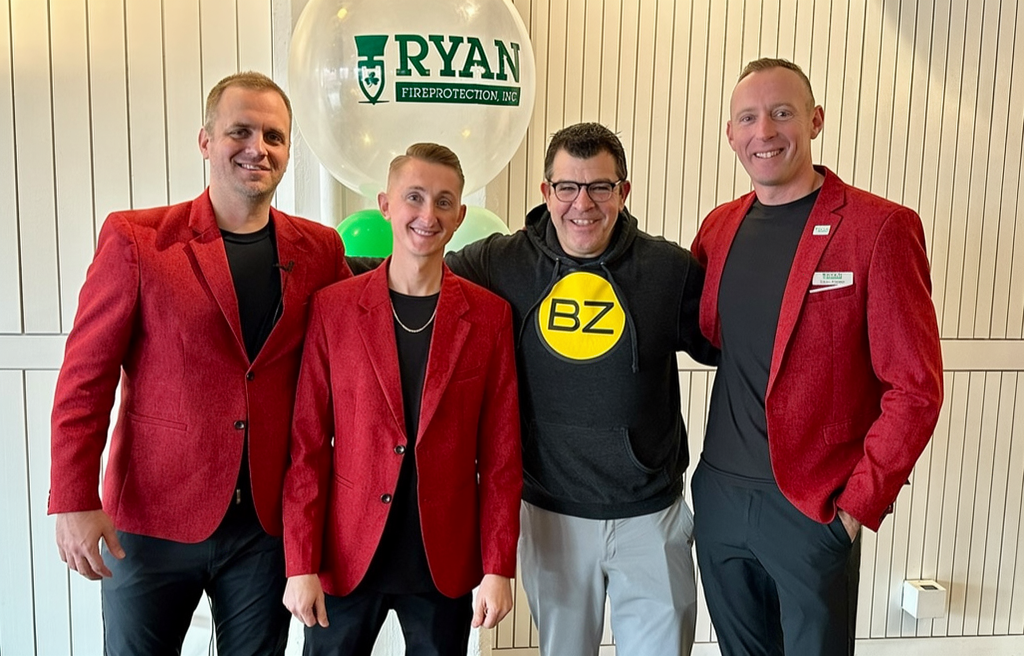
Ryan Fireprotection had a sales team full of hungry, experienced sellers. They were chasing real opportunities in complex markets: industrial, healthcare, commercial, with real money on the table...and they were losing more of those deals than they should have been.
Not because their reps weren't good. They were good. That was almost the problem.
When your team is talented enough to hit numbers without a system, it is easy to mistake activity for execution. Edwin Frieden, VP of Sales at Ryan Fire, saw it clearly: "We had high performers. People who were hungry. But we weren't giving them tools to help them win more of the opportunities they were already chasing."
That gap between effort and outcome is exactly what a Sales Operating System is built to close, and the results Ryan Fire got after implementing BZSOS make a compelling case for why the best sales teams in the country are ditching the heroics model for good.
Chaos Is Fine... Until You Try to Scale It.
Before BZSOS, Ryan Fire's sales function looked like a lot of B2B sales organizations at their stage. Strong individual contributors. Pipelines that grew quickly but weren't always clean. Forecasting that varied depending on which part of the business you were looking at. No consistent system defining how sales should actually be executed from one rep to the next.
The word Frieden used to describe it was "chaotic."
Chaos is survivable when the market is forgiving. It is not scalable when you have 60-plus salespeople and some of them are quoting 50 deals a month. At that volume, inconsistent execution does not just cost you deals. It costs you margin, time, and eventually, the ability to forecast anything with confidence.
Frieden did not need more training. He needed a Sales Process that every rep would actually run.
"Hope Is Not a Strategy. Talent Is Not a Strategy. Discipline Is."
That quote is Frieden's own, and it captures exactly why Ryan Fire moved forward with BZSOS after evaluating it. Like most sales leaders, his first question was about ROI. How do you measure the return on a Sales Operating System?
The answer, it turns out, is pretty straightforward when you are looking at the right metric.
Ryan Fire zeroed in on capture rate: the percentage of opportunities pursued that actually convert to wins. Before BZSOS, the standard benchmark hovered around 50%. After implementation, top performers climbed to roughly 80%. Lower performers moved into the 50-60% range. The stated team goal became 75%.
That is a 25% improvement in win rate. On a high-volume pipeline, that number is not a footnote. It is the whole story.
"We're selling more by doing less," Frieden said. "That's the goal."
What BZSOS Actually Is (And What It Is Not)
Frieden has a sharp way of explaining it. "It's like the iOS for your phone. It's not the apps. It's how you move between them."
BZSOS is not software. It is not a two-day workshop where reps sit through slide decks and take a quiz. It is the operating layer that defines how sales gets done, how opportunities are managed, how deals move forward, what "next step" actually means, and what every rep is expected to do at every stage of the process.
Before BZSOS, Ryan Fire's sellers were running their own versions of a sales process, shaped by their instincts and experience. Some of those individual systems were excellent. But excellence that lives in one person's head does not scale.
"It helped us define how we go sell," Frieden said, "not just how we do business."
That shift from individual interpretation to shared Sales Execution is the core of what BZSOS delivers. Shared language. Defined pipeline standards. Clear expectations for how opportunities get vetted and how deals move. The team is not only speaking the same language now, they are running the same plays.
Accountability Without the Nagging
One of the more underrated results Ryan Fire saw was the change in how accountability showed up inside the team. This is where a lot of sales organizations get it wrong.
Most accountability conversations are manager-driven. Someone is not hitting their number, so there's a meeting. There is pressure. There is a "what's going on with your pipeline" conversation that neither party enjoys. It doesn't fix anything because the visibility was already too late.
With BZSOS in place, Ryan Fire moved to accountability driven by the system itself. CRM discipline improved, not because someone was enforcing data entry, but because clean data became necessary for sellers to execute well. Frieden's team cleans the pipeline once a quarter. At 50 quotes per seller per month, that kind of hygiene is not optional. It's survival.
When the system creates visibility, managers stop policing and start coaching, and that makes all the difference.
The Reps Nobody Expected to Win
Here is something Frieden mentioned that deserves its own spotlight. With a 60-person sales team, leadership expected some resistance to a new system. They got adoption instead.
And some of the strongest adoption came from the least expected places.
"People you wouldn't expect, maybe not the most organized, maybe a little quirky, they became some of our highest performers," Frieden said.
That is what a well-designed Sales Operating System does that talent alone cannot. It gives structure to people who are capable but disorganized. It gives language to people who are sharp but inconsistent. It removes the invisible ceiling that stops a solid rep from becoming a great one. They didn't lack the skill, they just lacked the system.
Full adoption did not happen overnight. Frieden puts the timeline at three to six months before the team was consistently using the tools and the capture rate started climbing. "That's when I knew...it's working."
Two Very Different Sales Environments. One System.
Ryan Fire operates across two distinct sales motions. Construction is relatively predictable. Longer cycles, forecastable revenue. Service work is reactive, harder to plan around, and historically difficult to forecast with confidence.
BZSOS brought greater clarity to both. In the service business specifically, better vetting and process discipline made opportunities more understandable and expectations more realistic. Revenue became more predictable over time, even in an environment that does not always cooperate.
Frieden credits the system with delivering something that no amount of talent could guarantee on its own: repeatability. "It creates predictable outcomes," he said. "And that's everything."
If You Are Still Running on Instinct, Read This Part Twice
Frieden's advice to other sales leaders is direct: talk to companies using BZSOS, talk to the reps using it, and ask hard questions. He is also clear about who the system is actually for.
"It's not for the CEO. It's not for the VP. It's for the sellers."
That framing matters. A Sales Operating System only delivers results when the people executing it see it as a tool that helps them win, not a compliance exercise designed to help management monitor them. BZSOS is built for adoption by design. The system sticks because it actually makes it easier to sell.
Ryan Fire came in with a strong team and left with a system. The 25% improvement in capture rate followed. The margin goals followed. The forecast clarity followed. None of that happens by accident, and none of it happens by running harder without running smarter.
You do not have a talent problem. You have a systems problem.
If you want to see more on what a Sales Operating System can do for your team, read the full Ryan Fireprotection Case Study or contact us here!




Align every step for every rep

