Why sales training fails before your reps ever get a chance to use it, and what actually makes behavior change stick.
Sales training doesn’t “just fail” with no explanation, it fails for the same few reasons, over and over. This is the first edition in our newest blog series, where we break down the eight reasons why sales training fails, and what's actually happening underneath each one.
Training presents “new” knowledge, motivational quotes, and sometimes even a helpful tactic or way of thinking. But, even the best methodologies struggle…Because training is merely an event. Selling is a system.
Each article tackles a single failure mode and shows how a Sales Operating System turns concepts into daily, observable behavior, so your sales process actually gets followed, reinforced, and sustained.
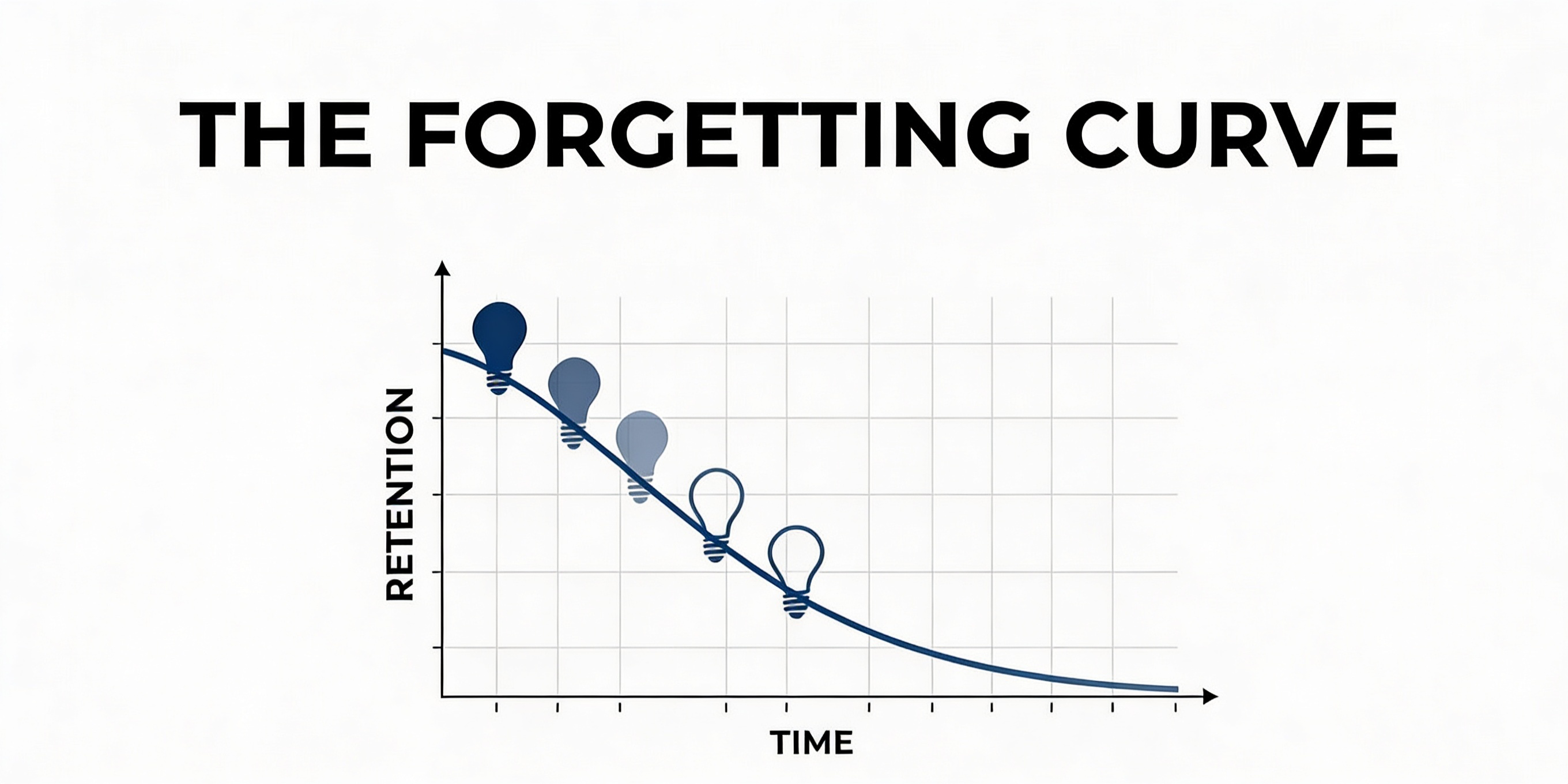
If you’re wondering why sales training fails, the forgetting curve is the first place to look. Not because your reps are lazy. Not because the trainer wasn’t good. But because human memory works the same way it always has, and most sales training ignores that reality completely.
The short version:
You didn’t buy behavior change.
You bought an information transfer.
And information without a system evaporates.
What is the forgetting curve, and why does it matter in sales?
In the late 1800s, psychologist Hermann Ebbinghaus mapped how quickly humans forget new information. His research showed that:
- Roughly 50% is forgotten within an hour
- About two-thirds within a day
- Up to 80% within a month
(unless there is deliberate reinforcement)
More than a century later, the data still holds.
Now layer that over how most sales training actually works:
- Two days offsite or virtual
- Dense concepts and frameworks
- A workbook or slide deck
- A kickoff email on Monday
Then it’s back to pressures of quotas and management expectations…and the old ways of selling along with it.
There is no reinforcement system. Just the calendar moving forward and deals demanding attention. When a rep finally hits a real opportunity where the new behavior matters ( prospecting, qualifying leads, setting next steps), the training is already gone.
They don’t consciously reject it, they simply can’t access it properly to its full potential.
That’s the forgetting curve at work.
Why sales training fails even when the content is “good”
This is where many sales leaders get stuck.
They say:
“The training was solid. The reps liked it.”
Both of those things can be true…and also completely irrelevant, because “liking” training is not the same thing as running a sales process differently on Wednesday at 2pm.
Sales training usually answers questions like:
- What should I say on a discovery call?
- What questions should I ask?
- How should I think about objection handling?
But selling doesn’t break down in theory. It breaks down in execution. By the time the rep is rushing between calls, updating the CRM late in a workday, or trying to move a stalled deal forward, their brain reaches for what’s easiest and most familiar: all those old behaviors that the training was supposed to replace!
Not because those habits are better, but because they’re still there.
The real problem: sales training treats selling like trivia
Here’s the uncomfortable truth most sales consulting won’t say out loud: Sales training often treats selling like trivia.
“If we just tell people cookie cutter answers, they’ll remember them and use them when it matters!”
But selling isn’t a test. It’s a job with interruptions, pressures, emotional stakes, competing priorities. That’s why knowing and doing are completely different problems, training solves for knowledge, Sales requires execution.
Execution sticks when the system does the remembering for the reps. Salespeople are free to focus on operating within the process that’s laid out! Less worrying about a sales tip “pop quiz”, more time spent doing what they do best: SELL!
This is why “more training” never fixes the problem
When the first training doesn’t stick, the usual response is predictable:
- Another methodology
- A refresher workshop
- A new trainer with “better engagement”
- A different sales process deck
But you’re still fighting the same physics. You’re trying to solve an ongoing execution problem with a one-time event.
That’s why:
- Sandler training stops showing up in deals
- Challenger language fades from pipeline reviews
- MEDDIC turns into a few half-filled CRM fields
It’s not that sales methodology implementation is impossible, it’s that methodology without an execution layer has no way to survive the forgetting curve.
What actually prevents the forgetting curve in sales?
There is only one proven way to beat the forgetting curve: Deliberate, ongoing reinforcement tied to real work.
Not empty reminders. Not motivational posters. Not “remember what we learned last quarter.”
Reinforcement looks like system tools used daily inside the sales process, standards that managers can inspect cleanly (no nagging!), a smooth, disciplined rhythm driving real results.
In other words: The process becomes the memory. This is where the idea of a sales operating system for your sales team becomes non-negotiable.
How a Sales Operating System solves the forgetting curve
A Sales Operating System exists for one reason: To make execution repeatable without relying on memory, motivation, or heroics.
Instead of asking:
“Do you remember what the methodology for prospecting is?”
The system says:
- Here is the prospecting SOP
- Here is the artifact you produce
- Here is where it lives in the CRM
- Here is how your manager inspects it
Instead of hoping reps recall training:
- The behavior is embedded in the workflow
- Reinforced in deal reviews
- Visible in pipeline inspections
- Tied directly to forecast accuracy
That’s how you make sales process adoption real, not theoretical.
Why does sales training fall to the forgetting curve? Because nothing pulls it into the rep’s actual day.
BZSOS was designed to do the opposite, here’s how:
1. One tool at a time
Instead of overwhelming reps, BZSOS introduces one executable sales tool per month - something they can use immediately on live deals.
2. SOPs, not concepts
Every tool is a step-by-step SOP, not a philosophy.
Concept → Task → Artifact → Inspection.
3. Ongoing rhythm beats memory
Customer-hosted meetings, BZ-hosted sessions, LMS access, and leadership inspections happen continuously.
There is no finish line, because selling doesn’t stop.
4. Leadership reinforcement (the real differentiator)
Managers don’t “hope” reps remember. They inspect execution using the same sales manager coaching frameworks, every time.
When the system is the boss, the forgetting curve loses.
The executive takeaway
If you’re frustrated that:
- Your sales process isn’t being followed
- Your CRM isn’t trusted
- Your forecast accuracy is shaky
- Your reps revert after every training
The issue isn’t effort, intelligence, or trainer quality. It’s that training alone cannot survive the forgetting curve.
Execution needs a system.
TL;DR for skimmers
Why sales training fails:
Because it relies on memory in a job that punishes forgetting.
What works instead:
A Sales Operating System that makes execution visible, repeatable, and reinforced…without constant enforcement.
That’s the difference between “knowing” how to sell
and actually selling differently next quarter.
Explore all eight reasons sales training breaks down and the Sales Operating System built to solve them here on our Why Sales Training Fails page!




Align every step for every rep

