
Why Sales Training Fails
And what to do instead if you want your reps to sell differently next quarter.
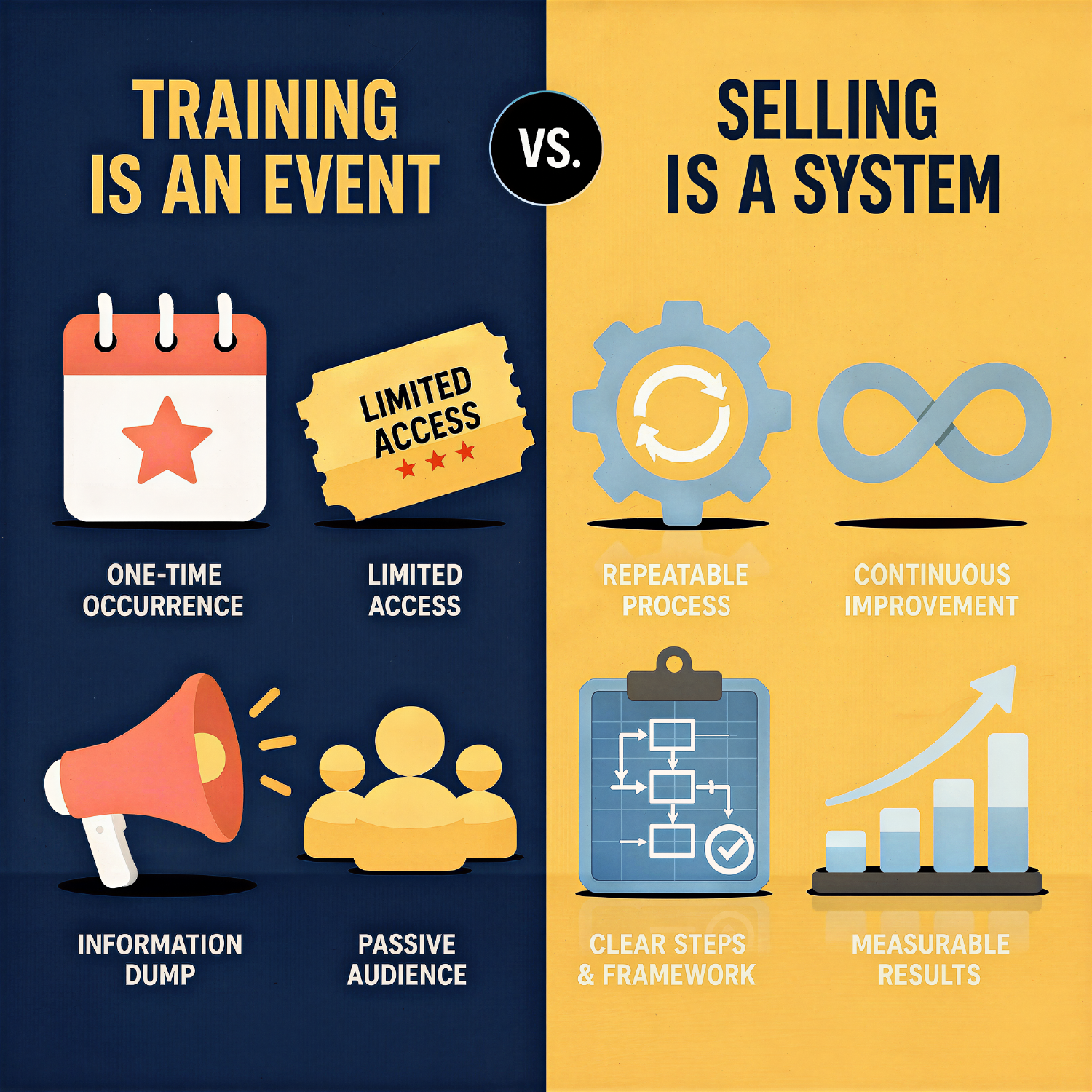
Sales training fails not because the content is bad, but because training is an event and selling is a daily habit. Reps leave fired up, the forgetting curve kicks in, everyone drifts back to their own version of the process, and a quarter later you can't tell it happened. Training transfers knowledge; it doesn't install the shared process, reinforcement, coaching, and execution habits that actually change how reps sell.
The uncomfortable truth about sales training
Harvard Business Review tells us that every year, companies spend somewhere north of $70 billion on sales training. By most estimates, 84% of that content is forgotten within 90 days. That's not a training problem. That's a system problem.
If you're a VP of Sales, CRO, or CEO who's signed off on a six-figure training initiative (Sandler, Challenger, MEDDIC, custom curriculum, the works) and then watched, six months later, as nothing about how your team actually sells looked any different… you're not alone. You're not even unusual. You're the rule.
Sales training fails for the same reason a New Year's resolution fails: knowing something and doing something every day are two completely different problems. Training tackles the first one. It almost never touches the second.
This is the ultimate guide to why sales training fails, what's really going on underneath the failure, and what to build instead — a Sales Operating System — if you want consistent execution, a coachable team, and a forecast you can actually trust.
Buckle up. We're going to be honest.
$70B spent on sales training annually. 84% forgotten within 90 days.
What this guide covers
- The core problem: training is an event, selling is a system
- The 8 reasons sales training fails (every time)
- What should replace sales training (hint: it's not more training)
- The sales operating system category, explained
- How BZSOS works in the real world
- A self-diagnostic: are you running on a system or running on hope?
- Where to start
The core problem: Training is an event. Selling is a system.
Let's start with the foundational misdiagnosis, because every other failure flows from this one.
Sales training assumes the problem is what your reps know. You take your best seller, study what they do, codify it, run the workshop. And the rest of the team still doesn’t sell differently.
That model has a fatal flaw. It treats selling like trivia. It doesn't account for what actually happens between Tuesday's training session and Thursday's discovery call: nothing. There's no scaffolding. No checklist. No daily artifact that pulls the new behavior into the rep's actual day. So they default to whatever they were doing before, because what they were doing before is what got them to "good enough." And "good enough" is comfortable.
Selling isn't a knowledge problem. It's an execution problem. Your sales process doesn't need more PowerPoint. It needs a system that makes it run every day. And execution problems are solved by systems, not events.
This is the single most important reframe in this entire guide. Once you see it, you can't unsee it. Every reason sales training fails — every single one — traces back to this gap between "we taught them" and "they actually do it on Wednesday at 2pm."
The 8 reasons sales training fails
1. The forgetting curve eats your investment alive
Hermann Ebbinghaus mapped this out in the 1880s and the data has held up ever since: people forget roughly half of what they learn within an hour, two-thirds within a day, and somewhere around 80% within a month - unless there's deliberate reinforcement.
Most sales training is two days in a hotel ballroom, a binder, and a Monday morning kickoff email. There is no deliberate reinforcement. There is just the calendar marching forward and the pipeline demanding attention.
By the time your reps hit a real opportunity where the new behavior matters, the new behavior is gone. They run the old playbook because the old playbook is what's left in their head.
What's really going on: You didn't buy a behavior change. You bought an information transfer. Those are different products. One of them stays. The other one evaporates.
LEARN MORE ABOUT THE FORGETTING CURVE
2. There's no shared process to coach against
Here's a question worth sitting with: when your sales manager sits down with a rep to coach a stuck deal, what exactly are they coaching against?
In most organizations, the answer is "their own experience." Your sales process (assuming you have one written down somewhere) might say one thing. Manager A coaches a different thing. Manager B coaches another. Both of them are basically running their own personal playbook, drawn from how they sold when they were reps, which was a decade ago in a different market with different buyers.
Training doesn't fix this. Training adds another layer of language on top of the manager's existing instincts. Now you've got a manager who learned to sell in 2014, picked up Sandler vocabulary in 2021, ran a Challenger workshop in 2024, and is now trying to coach a 2026 deal using some Frankenstein blend of all three.
Coaching only works when there is a shared, standardized sales process to coach against. Without one, every coaching conversation is a Rorschach test — both parties see something different in the same deal.
What's really going on: "We need better coaching" is almost always a misdiagnosis. You don't need better coaching. You need a sales process that's actually run the same way by everyone, so there's something to coach against.
LEARN MORE ABOUT COACHING AGAINST PROCESS
3. Training and CRM live in separate universes
Walk through any mid-market B2B sales org and you'll find two parallel realities.
Reality #1 is the training reality. The methodology slides. The discovery framework. The objection-handling playbook. The qualification model.
Reality #2 is the CRM reality. The pipeline stages. The required fields. The forecast categories. The activity tracking.
These two realities don't talk to each other. The training tells reps to ask questions about implementation timeline. The CRM has a field for "next step" that nobody fills in. The training says "use a mutual action plan." The CRM has no place to put one.
So reps either run the methodology in their head and then update the CRM with the bare minimum, or they update the CRM diligently and ignore the methodology. Either way, the two systems never converge. Your training doesn't show up in your pipeline data, and your pipeline data doesn't reflect what your training actually taught.
What's really going on: Training and CRM are tools. Tools need to plug into a system. Without the system, the tools just sit there pretending they're working.
LEARN MORE ABOUT CRM ALIGNMENT
4. Methodology is what to say. Execution is what to do.
There is nothing wrong with Sandler. There is nothing wrong with Challenger, MEDDIC, SPIN, or any of the others. The problem isn't the methodology. The problem is that methodology answers the wrong question.
Methodology answers: What should the rep say in a discovery call?
Execution answers: Did the rep actually run a discovery call this week? With whom? What was the next step? Is it on the calendar? Has it been confirmed? What's the rep doing tomorrow about it?
Your team can be Sandler-trained and still have a forecast nobody believes, a CRM full of stale opportunities, and managers who spend their week chasing updates. The methodology isn’t broken. It’s just floating above the daily work, with nothing to anchor it to.
What's really going on: Methodology dies at the whiteboard. It needs an execution layer to convert "what to say" into "what to do on Wednesday." Most training programs don't ship with one.
LEARN MORE ABOUT METHODOLOGY VS EXECUTION
Methodology dies at the whiteboard. It needs an execution layer.
5. One-time events can't solve ongoing problems
Sales isn't a thing that happens to your reps once. It happens to them every single day. Buyers ghost. Deals stall. New objections show up. Champions get reorged. The pipeline is constantly being rewritten by reality.
A two-day training event treats sales like a single-payer problem: pay once, fixed forever. But the problem isn't fixed. The problem is recurring. The problem is the job.
This is why the second training, the third training, the fourth training all keep getting bought. Each one promises this time it'll stick. Each one is fighting the same battle: an event-based intervention attempting to change a daily-rhythm reality. The math doesn't work.
What's really going on: Anything you want to happen consistently in selling needs to be wired into the daily rhythm of the team. Workshops can't do that. Only operating systems can.
LEARN MORE ABOUT WHY ONE-TIME EVENTS DON'T FIX THE PROBLEM
6. Top reps get promoted into leadership with no management system
Here’s the move that quietly breaks more sales orgs than anything else: your best seller gets promoted to sales manager.
They were excellent at running their own deals. They had a feel for it. They could read a buyer in 30 seconds. They closed when others couldn’t. So they get the keys to the manager’s office and a team of six. And suddenly the job looks nothing like what made them great.
Because now the role is completely different. The job isn’t selling. The job is making other people sell. That requires inspection systems, coaching frameworks, deal review structures, scoreboards, calendar management, and a way to teach behaviors without doing the deals yourself. None of which your new manager ever had to learn.
Sales training rarely addresses this. When it does, it shows up as "manager coaching skills" - a soft-skills overlay that teaches them how to have better conversations. But coaching conversations without a system to coach against (see Reason #2) is just feelings exchanged in a 1:1.
What's really going on: You promoted great sellers and asked them to be great managers. That’s a different job. It needs a different operating system. And they’re not going to invent it on their own.
LEARN MORE ABOUT NEW LEADERS WITH NO SYSTEM
7. Accountability is treated as a personality trait, not a process
If you ask most sales leaders how they hold reps accountable, you'll get some version of: "I push them. I expect a lot. I'm direct."
Translation: I nag.
Accountability via nagging works for exactly as long as you have the energy to keep doing it. The minute you get pulled into a strategic project, a board meeting, a regional travel week, a couple of customer escalations, accountability evaporates. Because it was never built into the system. It was being held up by your force of will.
Sales training tends to make this worse, not better. The training arrives, you champion it for two weeks, then attention drifts and the training drifts with it. Your reps know the cycle. They wait it out.
Real accountability is structural. It comes from clarity (everyone knows what the standard is), scoreboards (everyone can see where they stand), and shared expectations (the process is the boss, not the leader's mood). When accountability is structural, it survives a leader going on vacation. When it's personality-driven, it doesn't survive lunch.
What's really going on: You don't have an accountability problem. You have a structural absence of accountability that you've been papering over with effort.
LEARN MORE ABOUT ACCOUNTABILITY BY PROCESS, NOT NAGGING
8. Sales execution is invisible - so it can't be improved
This is the failure that contains all the others.
You cannot improve what you cannot see. And in most sales organizations, the actual execution (what reps are doing every day, in what order, with what quality) is invisible. You see CRM data, but CRM data is a thin shadow of execution. It tells you the deal moved to “Negotiation.” It doesn’t tell you whether the rep ran a real discovery, discussed the economics of the deal, set a mutual timeline agreement, or just guessed.
Training compounds this problem. It introduces new behaviors that are even harder to see than the old ones. Did the rep run the Challenger reframe? Did they execute the BANT recovery? Who knows. The behavior happens in a Zoom room with two people, and the only artifact is a CRM note that says "good call."
If execution is invisible, coaching is theater, forecasting is fiction, and training is hope.
What's really going on: Making sales execution visible is the precondition for everything else. Until that's solved, training is just expensive entertainment.
LEARN MORE ABOUT MAKING SALES EXECUTION VISIBLE
What replaces sales training: a Sales Operating System
Here's where the conversation shifts.
Once you accept that the problem is execution and not knowledge, you stop asking "what's the best training program?" and start asking a much better question:
What would it look like if my sales team ran on a Sales Operating System?
The same way Marketing runs on HubSpot. The same way Finance runs on NetSuite. The same way Operations runs on a documented set of SOPs that don't require anyone to remember anything because the process is the memory.
That's a sales operating system. And it's a different category of solution than training.
The Sales Operating System category, explained
Let's be precise about the category, because this is where most people get confused.
A Sales Operating System is not training. It's not methodology. It's not CRM. It's not a static playbook. It's the layer that sits between all of those and makes them actually run as a unified system.
Think of it the way business operating systems work for the rest of your company. Whether you’re running EOS (Entrepreneurial Operating System), Scaling Up, Great Game of Business, Franklin Covey’s 4 Disciplines of Execution, or something home-grown - those frameworks give your leadership team a common language, shared rhythms, and a way to make the whole business run without depending on any one person’s memory or personality. They don’t replace your strategy, your people, or your finance stack. They’re the operating discipline that makes everything else work together: the meeting rhythms, the scorecards, the accountabilities, the documented processes. A Sales Operating System is the same idea applied specifically to the revenue function.
A Sales Operating System is the same idea applied to the sales function. It's the layer that turns your sales process from a document in a Google Drive folder into a system your reps and managers actually run every day:
- SOPs for reps: daily tools and step-by-step checklists that take the abstract ("run great discovery") and turn it into the concrete ("here are the four questions, here's the artifact you produce, here's where it goes in the CRM, here's when the next step is on the calendar").
- SOPs for leaders: inspection frameworks, coaching guides, deal review structures, calendar audits. The leader doesn't have to invent their management style from scratch.
- Operational KPIs: metrics that connect daily behaviors to deal outcomes, so leaders can see what's happening before the number is already missed.
A Sales Operating System is CRM-agnostic (works with Salesforce, HubSpot, Pipedrive, a spreadsheet - doesn't matter), methodology-agnostic (doesn't replace Sandler, Challenger, or whatever you've invested in), and built to amplify what you already have rather than rip it out.
That last part is important. Most sales teams already have some version of a sales process. They have some training in their history. They have some CRM hygiene. What they don't have is the connective tissue that makes those things run together every day.
That's the operating system.
How BZSOS works in practice
The Blind Zebra Sales Operating System (BZSOS) is the Sales Operating System version of what most companies are trying to buy when they buy sales training. Here's what makes it actually different in execution:
One sales tool per month, on top of what you already have
BZSOS doesn't ask your team to drop everything and learn a new methodology. Each month introduces one tool - a Personal Business Plan, a Mutual Timeline Agreement, a Deal Inspection Guide, a Calendar Inspection Guide - that solves a specific, recurring sales problem.
The tools are designed to live inside whatever sales process you already run. They don't replace your stages, your fields, your methodology, or your team's habits. They give your team something concrete to do, with a defined artifact and a defined next step, so the abstract becomes observable.
The leadership operating system (this is the real moat)
Most “sales training” stops at the rep. BZSOS treats sales leadership as its own discipline with its own plays. Inspection systems. Coaching frameworks. Deal processing guides. People evaluators. The stuff a new manager would otherwise have to invent on their own — which means they’d either skip it or do a worse version of it than your top performers deserve.
When you bring BZSOS in, you’re not really buying rep training. You’re buying management consistency: every leader on your team inspects deals the same way, against the same standards, with the same artifacts. That’s how your team scales without depending on the personality of any one leader.
An ongoing rhythm, not a finish line
This is the part that separates an operating system from a training program.
BZSOS runs on an ongoing rhythm: customer-hosted internal meetings twice a month, BZ-hosted calls twice a month, Coach on Call support for urgent deal and leader issues, monthly all-team enablement, and a nationwide BZ Community of certified teams to learn from. There is no graduation. There is no "we finished BZSOS." The system keeps running because the job of selling keeps happening.
That rhythm is the reason behavior change actually sticks. There is no forgetting curve when the behavior is reinforced every two weeks by the system itself.
Two delivery layers, both designed for adoption
- The BZSOS Binder: workbook-style lessons with every tool in one place. Tactile. Lives on the desk. Gets used.
- The BZSOS LMS: always-on, on-demand video courses for reps to revisit anytime. So when the rep needs the play, the play is right there. Not in their memory from a workshop nine months ago.
Adoption isn't forced. It happens because the tools genuinely make selling easier. That's by design. If the tool doesn't make a rep better at their job tomorrow, it doesn't belong in the system.
How BZSOS solves each of these 8 failures
Quick callback, because this is the punchline:
That's not a coincidence. BZSOS was reverse-engineered from these exact failure modes.
Self-diagnostic: are you running on a system or running on hope?
Score yourself. Each statement is worth one point if you can honestly answer yes.
Score 6+: You're running on a system. Keep tuning it.
Score 3–5: You're running on a partial system propped up by your best people. It works until they leave or get tired.
Score 0–2: You're running on hope. Hope is not a strategy. And it's not a forecast.
Where to start
If this resonated, here's the honest progression.
First, stop buying training expecting it to fix execution. You can keep your existing methodology (Sandler, Challenger, whatever) and we'd actually encourage you to. BZSOS isn't here to replace your investment. It's here to make it run.
Second, find out if your team is a fit for a Sales Operating System. Not every team is. BZSOS works best for B2B teams with 8+ reps (strongest at 15–100+), a multi-step sales cycle, a CRM in place but not fully trusted, and leadership accountable for forecast accuracy. If that's you, we should probably talk.
Third, expect this to take more than a quarter to land. Operating systems aren't installed in a workshop. They're installed in a rhythm. The rhythm is the point.
We do something called a Coin Toss Convo - a 15-minute first conversation where we figure out if BZSOS is a fit for your team. No pitch, no nurture sequence. You'll know by the end of the call whether it's worth a second conversation.
If you've been wondering why your last training initiative didn't stick (or your last three didn't) that's probably the right place to start.
The TL;DR for the executives skimming
Why sales training fails, in one sentence: it tries to solve an execution problem with an information transfer. The reps forget what they learned. The managers have no shared sales process to coach against. The CRM and the training never converge. The methodology floats above the daily work. The event ends but the job continues. The promoted reps have no manager OS. Accountability runs on the leader's nagging stamina. And the actual selling stays invisible.
What works instead is a Sales Operating System: the layer between methodology, CRM, and people that makes the whole thing actually run.
BZSOS is one. There are others. The point is the category, not the brand. If your team doesn't have something in this category, you're going to keep paying for training that doesn't stick, because you'll keep buying the wrong tool for the actual problem.
One sales process. Repeatable results. A forecast you can fully and finally trust.
That's the bar. Anything less is hope dressed up as a strategy.
Ready to find out if BZSOS is the right operating system for your team? Schedule a Coin Toss Convo. Thirty minutes. Heads or tails on fit.




Align every step for every rep

