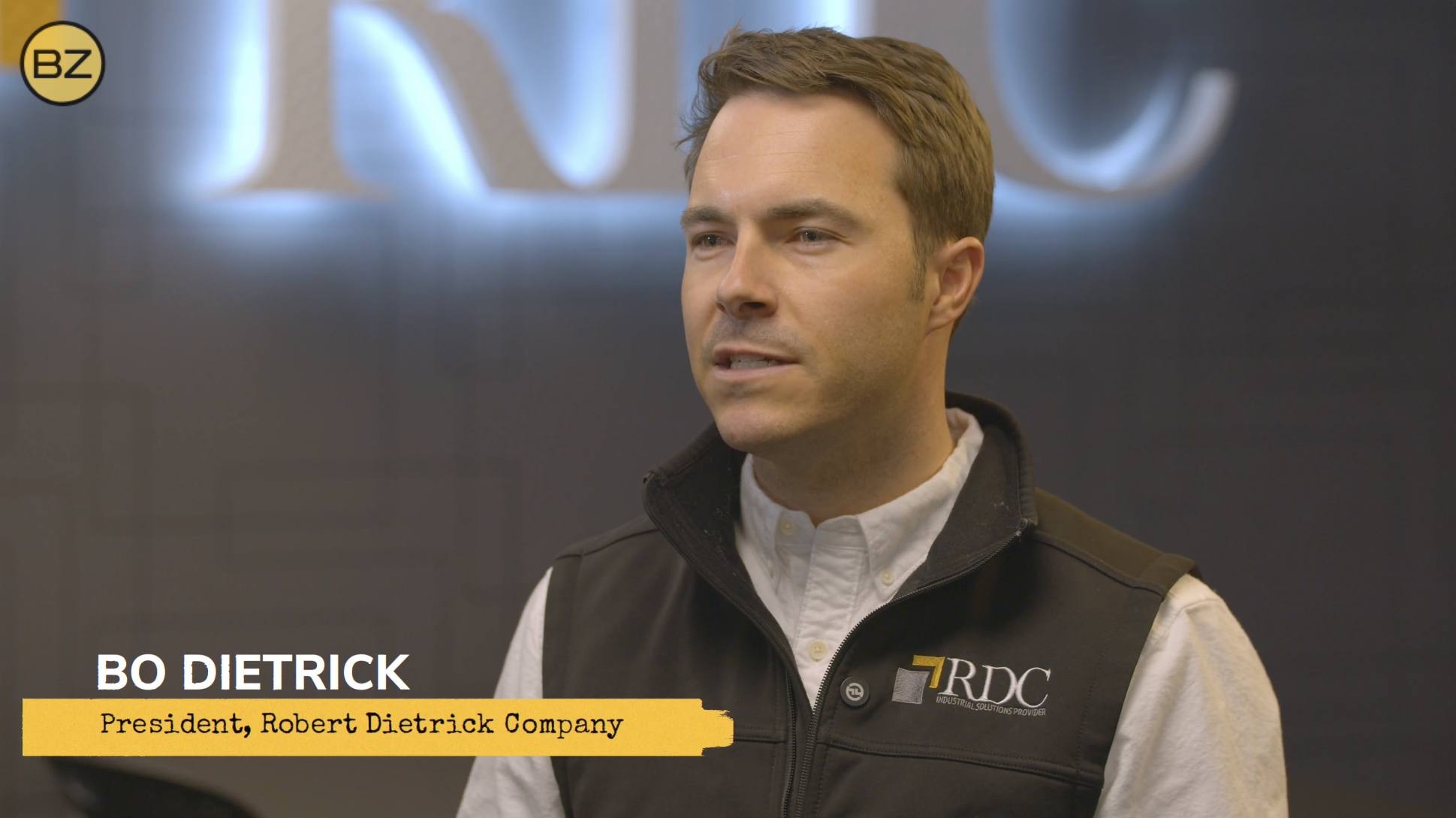
Robert Dietrick Company has been solving problems at loading docks and inside warehouses since 1969. Three generations of family leadership. Five Indiana branches. A sales team that spans reps who just started their careers and reps who have been closing complex industrial deals for 30 years. A 2026 Best Place to Work in Indiana. An industry-leading 0.6 safety EMR. By every measure, a company doing things right.
And they still had a consistency problem that was showing up with customers.
That is the part worth sitting with. If a company this well-run, this culturally healthy, this experienced, could have a sales team where every rep operated from their own personal playbook, what does that say about yours?
It says you probably have the same problem. And like RDC, you probably do not have a talent problem either.
Every Rep Had a System. None of Them Were the Same.
RDC President Bo Dietrick put it plainly: "Depending on who you worked with, you got a different experience. And for our business, it was really important that we deliver a consistent experience."
They heard it from customers first. And that is the worst place to hear it.
The symptoms were familiar to any sales leader who has managed a team of more than ten people. Reps operating as lone wolves with no shared language. A CRM that was more graveyard than pipeline, full of old opportunities nobody cleaned out. Forecasting that was basically guesswork, always stuck on the next deal that needed to close rather than what was coming in 90 days. Stalled opportunities that sat for weeks, then months, because nobody had a clear play for what to do when a customer went quiet.
None of that is a rep problem. RDC's reps were good. The problem was structural: there was no shared sales operating system defining how selling actually got done.
When leadership started evaluating BZSOS, Director of Sales Tanner Steel had the yellow flags any experienced sales leader would have. "Anytime you're working with sales folks, you never know what you're going to get. You've got people who lean in and people who are detached. The yellow flag is you don't know how culturally folks are going to embrace the tools, especially across different tenures. Are they just going to roll their eyes and walk out like some other sales training?"
Fair concern. Worth naming out loud.
One Tool. Installed on the Call. Deals Moving Within the Hour.
Here's what actually happened.
One of the first BZSOS tools RDC installed was the Stall Continuum. It is tactical. It is specific. It gives reps a concrete play for the exact moment most salespeople just stew in uncertainty: when a prospect has gone quiet and nobody knows what to say or whether to push.
Tanner describes what happened after it was introduced: "We installed it on the call and tasked everybody to go try it on a handful of their stalled opportunities. Within the hour, reps were reaching back out. Appointments were set. Deals that had gone cold were back in action. Meetings were on the calendar."
Not weeks later. Within the hour.
Deals closed in different territories that had been stalled for months, moved specifically because of that one tool. Bo saw the same thing from the top: conversations that used to take weeks to restart were moving forward in days, because his team finally had the language and strategy to communicate with customers in a stall.
That kind of immediate, measurable impact is exactly what separates a sales operating system built around execution from two days in a conference room learning a methodology you will half-remember by Friday.
What "One Tool at a Time" Actually Does to Your Team
Here is something that doesn't get talked about enough in sales leadership circles: the sequencing of how a system gets installed matters as much as what's in it.
BZSOS rolls out one tool per month. One play, practiced regularly, until it is muscle memory. Then the next one. Bo describes it as "plays in a playbook, so depending on the situation you're in, you have a play for every situation."
That structure solves a problem that kills most sales training investments before they even start: the forgetting curve. You cannot ask 40 reps to absorb an entire methodology in a single event and then expect consistent execution six months later. Learning has to be continuous, not compressed.
It also solved a specific challenge for RDC. They have a wide range of tenure on their team. A first-year rep and a 30-year veteran are not going to execute the same play the same way. But with BZSOS, they can run the same play from the same playbook and each get a result appropriate to where they are. As Tanner put it: "A new rep who's brand new in the field can use the same tools as reps who have been around for 30 years, just in a different way to get an impact."
One system. Every rep. No rep left inventing their own process.
And because RDC is in a period of heavy hiring, that matters enormously right now. A shared system means new reps get productive faster. They are not left to figure out their own way of selling while the veterans shake their heads. They come in, they learn the plays, they execute.
Your CRM Is Lying to You. Here's How to Fix It.
Clean pipeline. Trustworthy data. A forecast you can actually present to your board without hedging every number.
Most sales leaders have stopped expecting this. They have accepted a baseline level of CRM chaos as the cost of managing a sales team.
RDC's CRM before BZSOS was, in Bo's words, "pretty messy." Tanner's description is more vivid: "going into a month or a quarter where our CRM looks like the wild west." Things went in. Nothing came out. Forecasting was hard because nobody could tell what was real and what was wishful thinking sitting in a stage it did not belong in.
The Pipeline Cleanout tool inside BZSOS fixed that. But what happened around it was the more interesting story.
Three reps who had never worked together proactively scheduled a ProdPod™ to work through Pipeline Cleanout together. Nobody told them to. Nobody scheduled it for them. They organized themselves around a shared tool and a shared language. Tanner called it "a tremendous win" and noted it was something that had never happened before at RDC.
That is not a team that was forced into accountability. That is a team that adopted a system because the system helped them do their jobs better. Sales discipline that comes from rep buy-in rather than management pressure sticks in a way that mandates never will.
The result for RDC: a cleaner, more trustworthy CRM, clearer visibility into what is actually in the pipeline, and a completely different orientation toward the future. "Before BZSOS, we were focused on just closing deals and not worrying about forecasting," Bo said. "It has flipped us to believing we can be way more focused on the future, one month out, one quarter out, even one year out, instead of thinking every deal is the next last deal we need to close."
That is what a trustworthy forecast feels like. Most sales teams have forgotten.
When the Language Goes Beyond Sales
One of the more unexpected things Bo and Tanner described was what happened when the common language from BZSOS started spreading outside the sales team. Operations. Innovation. People in roles that had nothing to do with pipeline management started picking up the same language.
That's not a coincidence. When a system is built around how people want to be communicated with, and how problems actually get solved, it turns out to apply beyond one department.
For customers, the shift was direct: "Our conversations with customers have really improved by giving our salespeople a new perspective on how customers want to be communicated with. We feel like we're delivering a superior customer experience," Bo said.
That is the compounding value of one consistent sales process executed across an entire team. One rep has a great conversation. Another rep has a great conversation. A customer who has worked with three different RDC reps over the years gets a consistent experience every single time. That is a brand promise a system can keep. Individual heroics cannot.
What Bo and Tanner Would Tell You
Bo's advice to any leader still on the fence is worth printing out and taping to your monitor: "Challenge yourself: if I try this, what's the worst thing that could happen, and what's the best? For us, the upside has far outweighed the downside."
Tanner's take on BZSOS is worth quoting in full: "One of the guiding principles is balance, and there are a lot of reasons in the world today to lean out. I'd say lean in. The way people want to be treated and want their problems solved is common regardless of industry or product. It's an incredible set of tools and an incredible network of folks, well worth the investment in an outsized way."
And his yellow flags? The ones he walked in with about whether the team would roll their eyes? "Every time we go to install a tool, I see lights come on. I see people's eyes light up and gears start turning. We're not preaching. We're giving people real-time tools that create real-time impact. All those yellow flags are gone."
This Story Can Be Yours
RDC's results were not a fluke, and they were not built on exceptional talent that most companies cannot replicate. They came from installing a real sales operating system and running it consistently.
Bookings up. Deal velocity up. Stalled opportunities reactivated within the hour. A CRM they can trust. A forecast oriented toward the future. A team that went from lone wolves to one aligned group running shared plays, speaking shared language, and winning together.
Bo put it best at the end: "BZSOS is going to produce a new type of sales culture within your organization that you'll be really proud of, and something you can protect and keep with you for a long time."
Your team does not need more training events. It needs a system. That is exactly what BZSOS is built to give you.
If you'd like to see the full in-depth case study, it's here...and if this story sounds a lot like yours, let's talk.




Align every step for every rep

